
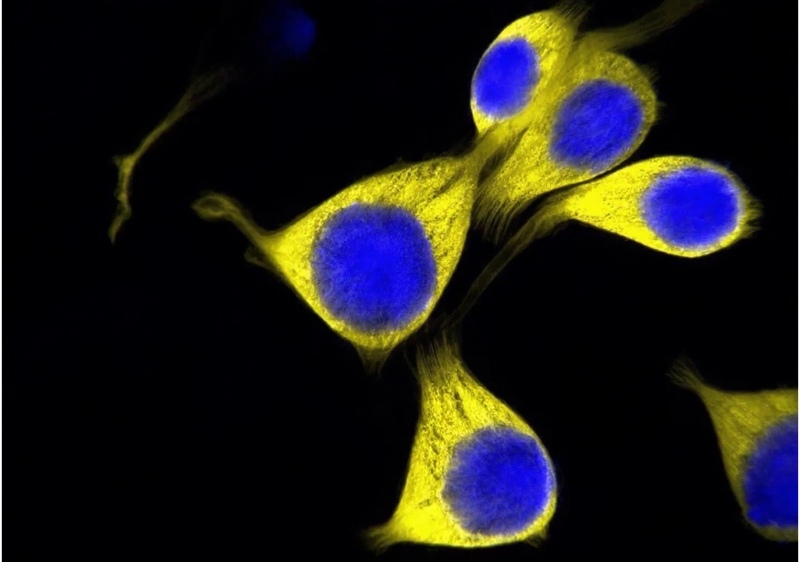
EO771 Cells for Study of "Remote Killing" Effect on Tumors Deciphered
As a critical component of comprehensive cancer treatment, radiotherapy has garnered significant attention in recent years not only for its local anti-tumor effects but also for its potential to activate systemic immune responses, leading to the regression of unirradiated distant tumors—the abscopal effect of radiotherapy. However, radiotherapy alone has limitations in inducing the abscopal effect, and the regulatory role of memory T cell subsets within tumor-draining lymph nodes (TDLNs) has not been fully elucidated. Therefore, in-depth investigation into the changes in memory T cell subsets within TDLNs and their associated gene regulatory networks is of great significance for understanding the mechanisms of the abscopal effect and its clinical application potential.Recently, a study conducted an in-depth exploration aimed at clarifying the induction of the abscopal effect by hypofractionated radiotherapy in breast cancer, focusing on the changes in memory T cell subsets within TDLNs and the key gene regulatory networks involved. Through a precisely designed animal experimental model, this study systematically revealed the immune mechanisms underlying the radiotherapy-induced abscopal effect.
Research Subjects and Methods
Radiotherapy RegimenThe study selected inbred C57BL/6J female mice and established a bilateral orthotopic EO771 monoclonal breast cancer tumor model to simulate clinical tumor development.
Experimental mice were randomly divided into an irradiation group (n=6) and a control group (n=6).
The left-sided tumors of mice in the irradiation group received a hypofractionated radiotherapy regimen (9 Gy per fraction, once daily for 3 consecutive days), while the control group received no treatment and served as observation controls. Tumor volumes were dynamically monitored. On the 9th day after radiotherapy completion, bilateral tumor tissues and TDLNs were harvested. Immune cell subset proportions were precisely analyzed using flow cytometry, gene expression changes were detected via transcriptome sequencing, and clinical correlation validation was performed using the TISIDB database.
Advance your breast cancer research with our EO771 cell series. Stable luciferase or OVA expression and proven in vivo performance make it ideal for systemic disease modeling and drug screening.
Order Now: EO771-Luc cell line, EO771-OVA Cell Line
Research Content
Key Areas of InvestigationThis study analyzed the following key aspects in detail at multiple levels:
1. Dynamic assessment of bilateral tumor growth to confirm the radiotherapy-induced abscopal effect.
2. Changes in the proportions of immune cell subsets in the tumor microenvironment to define local immune effects.
3. Fine dynamic changes in memory T cell subsets (CD8+ TRM and CD8+ TEM cells) within TDLNs.
4. Comprehensive analysis of differentially expressed genes in TDLNs using transcriptome sequencing.
5. Identification and clinical validation of key genes associated with memory T cells through bioinformatics analysis.
Research Results
Key FindingsValidation of the Radiotherapy-Induced Abscopal Effect
On day 9 post-irradiation, compared to the control group, the irradiation group exhibited a significant reduction in the volume of the irradiated-side tumors [(4.802±0.624) vs (164.313±16.451) mm³, t=9.689, P<0.001], and the abscopal (unirradiated) side tumors also showed marked inhibition [(17.990±7.048) vs (94.469±15.678) mm³, t=4.450, P=0.002]. The differences were statistically significant.
These data indicate that in the EO771 monoclonal bilateral orthotopic tumor model, hypofractionated radiotherapy successfully induced the abscopal effect.
· CD8+ T cell proportion in irradiated-side tumors:
Flow cytometry results on day 6 post-irradiation showed that, compared to the control group, the proportion of CD8+ T cells among live cells in the irradiated-side tumors of the irradiation group was decreased [(0.53±0.56)% vs (0.92±0.14)%], with a statistically significant difference (t=2.727, P=0.023). Differences in the proportions of other immune cell subsets were not statistically significant (all P>0.05).
· Immune cell proportions in abscopal (unirradiated) side tumors:
On day 9 post-irradiation, there were no statistically significant differences in the proportions of various immune cell subsets (including CD8+ T, CD4+ T cells) between the irradiation and control groups in the abscopal tumors (all P>0.05).
Dynamic Changes of Memory T Cells in TDLNs
· Cell subsets in irradiated-side TDLNs:
On day 9 post-irradiation, the proportions of CD4+ T cells in TDLNs were (64.87±1.63)% in the irradiation group and (44.51±2.35)% in the control group, a statistically significant difference (t=7.121, P<0.001). Analysis of memory T cell subsets revealed that in the irradiated-side TDLNs, the proportion of CD8+ TRM cells was (7.33±1.33)% in the irradiation group, higher than (3.03±0.46)% in the control group (t=3.050, P=0.016); the proportion of CD8+ TEM cells was (40.27±1.70)% in the irradiation group, higher than (33.18±1.05)% in the control group (t=3.559, P=0.007).
· Cell subsets in abscopal (unirradiated) side TDLNs:
The total CD8+ T cell proportion in the irradiation group was (10.21±1.55)%, lower than the control group's (16.86±1.94)% (t=2.600, P=0.029).
Furthermore, the proportions of CD8+ TRM and CD8+ TEM cells in the irradiation group were significantly elevated compared to the control group [TRM: (6.24±0.77)% vs (3.06±0.46)%, t=3.695, P=0.005; TEM: (38.93±1.17)% vs (29.14±2.51)%, t=3.297, P=0.009], with all differences being statistically significant.
Transcriptome Profiling Analysis of TDLNs
Transcriptome sequencing of bilateral TDLNs on day 9 post-irradiation revealed: in the irradiated-side TDLNs, compared to the control group, there were 293 differentially expressed genes (DEGs) in the irradiation group [|log₂(fold change)|>1, false discovery rate <0.05], including 243 upregulated and 50 downregulated genes; in the abscopal-side TDLNs, there were 326 DEGs, including 256 upregulated and 70 downregulated genes.
Further analysis identified 39 genes showing consistent differential expression trends in both ipsilateral and contralateral TDLNs, including genes involved in cell cycle regulation (Ccn5), interferon-induced genes (Gbp10), and genes regulating stem cell pluripotency (Lin28b). Gene functional enrichment analysis showed that these DEGs were significantly enriched in key immune regulatory processes such as T cell activation and proliferation, memory T cell differentiation, and cytokine-mediated signal transduction.
Clinical Validation of Memory T Cell-Associated Genes
Validation using the TISIDB database revealed that the expression of phosphodiesterase 6G (PDE6G), hepatic lipase C (LIPC), and myelin protein zero (MPZ) was positively correlated with the abundance of CD8+ TEM cells (rs = 0.643, 0.488, and 0.340, respectively, P<0.001). The expression of WNT1-inducible signaling pathway protein 2 (WISP2), PDE6G, and LIPC was positively correlated with the abundance of central memory CD8+ T (TCM) cells (rs = 0.387, 0.336, and 0.311, respectively, P<0.001)..
Conclusion
This study systematically elucidates the immune mechanism by which hypofractionated radiotherapy induces the abscopal effect in breast cancer: namely, by activating memory T cell subsets in TDLNs and upregulating key gene expression (e.g., Lin28b, PDE6G), ultimately achieving systemic immunosuppression of the tumor.The key genes identified in this study provide not only new potential targets for combined radiotherapy and immunotherapy but also a clear theoretical basis for subsequent in-depth research.
Future studies will continue to utilize gene editing and spatiotemporal dynamic monitoring technologies to further clarify the specific mechanisms of particular molecules in memory T cell activation and the abscopal effect, opening new prospects for clinical cancer therapy.
